
Radon Zone Map vs. Home Radon Test — What Each Can Tell You
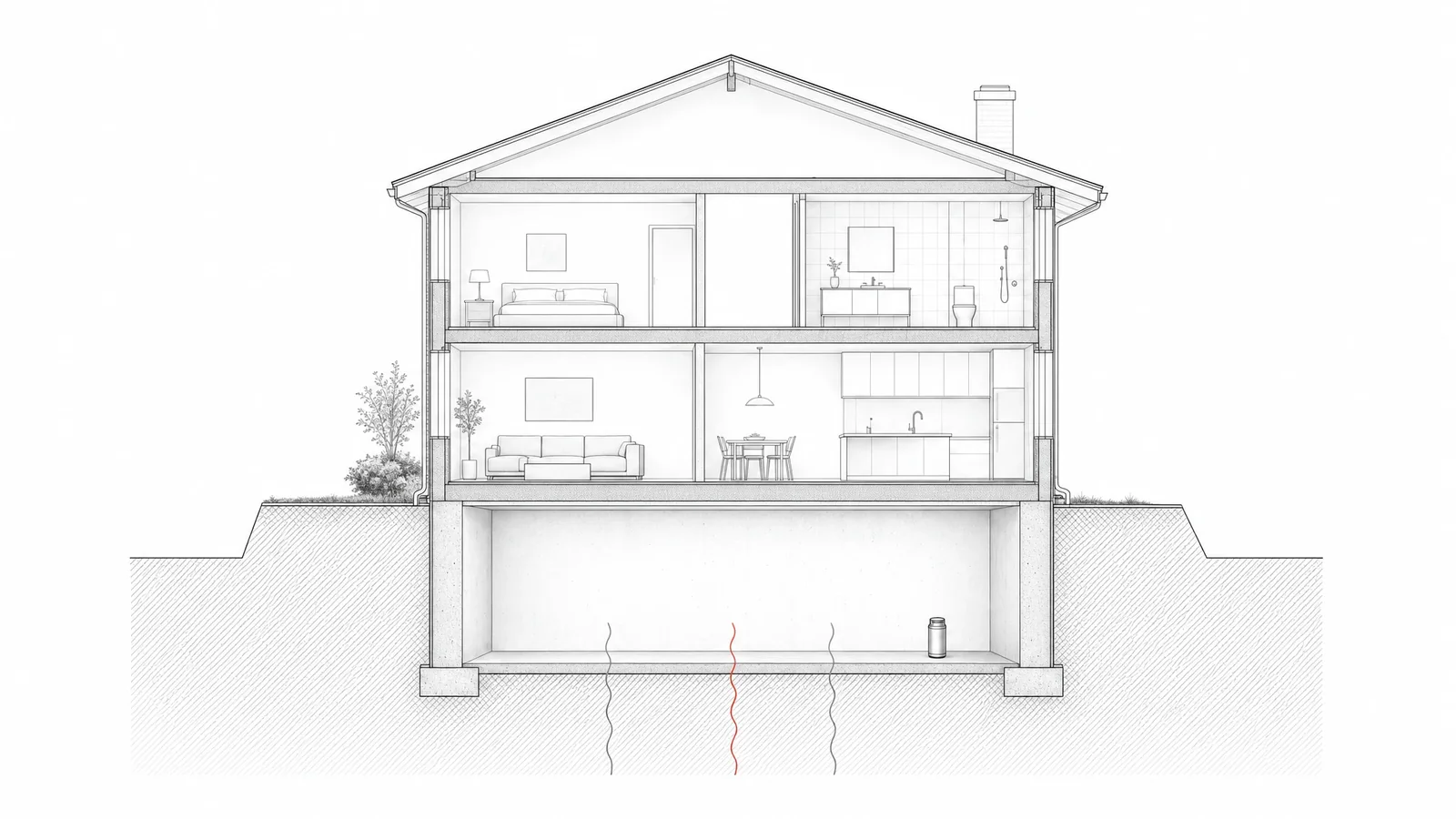
EPA's Map of Radon Zones cannot tell you whether the house you want has a radon problem. Published in 1993 to steer building codes and state radon programs, it works at the resolution of the county: a Zone 1 rating means the predicted indoor average there runs above 4 pCi/L, Zone 2 means somewhere between 2 and 4, and Zone 3 means below 2. Judging a single address was never its job. Indoor radon routinely differs tenfold between houses on the same street, so a county rating can neither clear nor condemn the home you are buying. Only a test run inside that home answers the question that matters. EPA's guidance is identical in all three zones: test.
Two questions, two instruments
The county map and the home test answer different questions, and the difference is the whole subject.
The map answers a policy question. Where should codes require radon-resistant construction in new homes. Where should a state health department spend its outreach budget. For those decisions, a county-level prediction is exactly the right resolution.
The test answers a private question. How much radon is in the air of this particular house, on this foundation, in this season, with the doors closed. No map can reach that resolution, and EPA's own Map of Radon Zones page says so directly: the map is not to be used to decide whether an individual home needs testing.
Buyers usually confuse the two in the reassuring direction. The county shows Zone 3, the area gets labeled "low radon," and the test gets waived to keep an offer lean. That logic mistakes an average for a measurement. Every year, some of the houses that read high sit in Zone 3 counties — and a test is the only way any of them get found.
How a county earns its zone
The 1993 method, developed jointly with the US Geological Survey, distilled several strands of evidence into one predicted average per county. Aerial gamma radioactivity surveys and surface geology described what the ground holds; soil permeability described how readily gas moves through it; existing indoor measurements, along with the foundation styles common to an area, described what local houses actually do with it. A county predicted to average past the 4 pCi/L action level became Zone 1; between 2 and 4, Zone 2; below 2, Zone 3.
Two consequences follow from that method.
The prediction is old. It has not been redrawn since 1993. Where states have gathered decades of actual indoor test results since then, the measured picture can differ from the prediction. Measured data lives elsewhere: the CDC Environmental Public Health Tracking Network — the destination EPA itself recommends — pools actual indoor results reported by participating states and radon laboratories.
The prediction is an average, and averages hide spread. Houses reading under 1 pCi/L exist inside Zone 1 counties, just as readings past 20 exist inside Zone 3 counties. The zone tells you which outcome is more likely, not which outcome you have.
The situation rhymes with flood mapping. FEMA's flood zones were drawn to administer an insurance program, and buyers who read them as house-level verdicts get surprised the same way — a pattern we cover in our guide to FEMA flood zone letters.
The three zones, in numbers
| Zone | Predicted county average | Typical code posture | For any one house |
|---|---|---|---|
| Zone 1 | Above 4 pCi/L | Radon-resistant new construction widely required | Higher odds of an elevated result — test |
| Zone 2 | 2 to 4 pCi/L | Requirements vary by state and municipality | Elevated houses are common — test |
| Zone 3 | Below 2 pCi/L | Rarely required | High readings still occur — test |
The right-hand column repeats itself on purpose. It is the only house-level conclusion the map supports.
The gas, in one paragraph
Radon is a radioactive gas released as uranium in soil and bedrock decays. It has no color, odor, or taste. Outdoors it dilutes to trivial concentrations; indoors it collects, drawn through slab cracks, cold joints, sump pits, crawlspace soil, and gaps around pipes by the slight vacuum a heated house pulls on the ground beneath it. Breathed over years at elevated levels, its decay products damage lung tissue. EPA's health risk figures attribute about 21,000 US lung cancer deaths per year to radon — the leading cause among people who have never smoked — and estimate that roughly one home in fifteen sits at or above the action level.
The unit, pCi/L, is picocuries per liter of air: a count of radioactive decays per second in a given volume. You need no more physics than this — 4 is the number that triggers action, and lower is better.
Why the house next door reads ten times higher
Two houses can share a fence and disagree completely, for reasons a county average cannot see.
The ground is not uniform. Uranium concentrations shift over tens of feet. A pocket of uranium-rich glacial till, or a bedrock fracture that channels soil gas, can sit under one lot and not the next.
Foundations differ. A basement in contact with soil on four sides collects more gas than a slab-on-grade, which collects more than a vented crawlspace. An unsealed sump pit is a direct pipe to the soil.
Houses breathe differently. Furnaces, water heaters, bathroom fans, and clothes dryers all exhaust indoor air, and the replacement air is pulled partly from the ground. Two identical floor plans with different mechanical systems can hold very different concentrations.
Time of year matters. Closed winter houses over frozen ground typically read higher than the same houses in mild weather. This is why test protocols control the conditions rather than trusting the calendar.
This variance is the entire case for testing. It is also why a seller's statement that "the neighbor tested fine" carries no information about the house you are writing an offer on.
The two thresholds worth memorizing
4 pCi/L is EPA's action level. At or above it, fix the house. Mitigation is routine and effective, so this number functions as a negotiation trigger, not an alarm.
2 to 4 pCi/L is EPA's "consider fixing" band. The EPA treats no concentration of the gas as harmless, and the World Health Organization sets its reference level lower, at 100 Bq/m³ — about 2.7 pCi/L. A house that tests at 3.5 passes the action-level test and still deserves a conversation about mitigation, especially if anyone will sleep in the basement.
Running a test inside a purchase window
A 7–10 day inspection contingency holds a radon test comfortably. The sequence:
- Book the measurement when you book the inspection. Many home inspectors carry radon certification; dedicated measurement professionals are the alternative. Certification matters — the National Radon Proficiency Program credential is the common standard, and some states additionally license testers.
- Close the house 12 hours before the test starts. Windows shut, exterior doors used only for normal coming and going, whole-house fans off. These closed-house conditions must hold for the entire measurement.
- Run the device for at least 48 hours. Transactions almost always use a continuous radon monitor, which logs a reading every hour. The hourly trace is your integrity check: a sudden dip on day two usually means someone opened a window, and it is visible.
- Place the device on the lowest level someone could live on. A basement that could ever be finished counts. Keep the monitor away from exterior doors, drafts, sumps, and high humidity.
- Read the result against the thresholds. At or above 4 pCi/L, invoke your contingency. Between 2 and 4, decide with the WHO reference in mind. Below 2, keep the report — it is a data point with a date on it, useful at resale.
- Retest if conditions were compromised. Severe storms, tampering, or a closed-house violation invalidate a result. The remedy is another 48 hours, not a lost deal.
EPA's Home Buyer's and Seller's Guide to Radon covers the transaction protocol in detail, including what sellers should disclose about past tests and existing systems.
The fix, priced before you negotiate
Knowing the repair cost before the test result arrives keeps the negotiation calm.
The standard fix is active soil depressurization: a sealed pipe through the slab (or, in a crawlspace, beneath a soil-covering membrane), an inline fan, and a vent above the roofline. The fan holds the soil under the house at lower pressure than the rooms above, so gas exits through the pipe instead of the floor. A properly built system removes as much as 99 percent of indoor radon, and installers usually finish inside a day.
Most single-family installations land between roughly $800 and $2,500, with a national midpoint near $1,200–$1,500. Finished basements, multiple suction points, and crawlspace membranes push toward the top of the range. Against the price of the house, this is a modest, well-understood line item — which is exactly how to present it to a seller.
A finished system asks three habits of its owner. Confirm the fix with a retest inside 30 days, once the fan has been running for at least a full day. Look at the U-tube manometer on the pipe now and then — it shows whether suction is holding. And put a fresh test on the calendar every two years, sooner if the house undergoes major renovation.
Writing radon into the offer
A clean radon contingency has three parts. Buyers who name all three avoid the vague clauses that stall closings.
The trigger. A specific number from a specified protocol — typically "4.0 pCi/L or higher on a test conducted under EPA closed-house conditions by a certified professional." Naming the protocol prevents arguments about an opened window.
The remedy. Either the seller installs an active mitigation system before closing, installed by a certified mitigator with a post-installation retest below the trigger, or the seller credits the buyer a stated amount at closing. A credit of $1,500–$2,500 covers most installations and lets you control the contractor choice.
The exit. If the seller declines both, the buyer may withdraw with the earnest money returned. In practice this clause is rarely exercised — radon negotiations settle, because the fix is cheap relative to the transaction — but it keeps the leverage where it belongs.
If the house already has a system, shift the contingency toward verification: a current test result below 4 pCi/L and documentation of the installation.
Questions to ask before you waive anything
- Has the house been tested before — and does the seller still have the report, with a date on it?
- Is there an existing mitigation system, and does the manometer show the fan is pulling suction?
- If a system exists, when was the last post-mitigation retest, and what did it read?
- Was the transaction test run under closed-house conditions, with an hourly log from a continuous monitor?
- Which level was tested — and will anyone sleep or work a level below it?
- Does the state license radon measurement professionals, and is the tester credentialed through NRPP or an equivalent program?
- Is the house in a Zone 1 county where new construction should have included radon-resistant features — and if so, were they ever activated with a fan and tested?
A "no" or a shrug on any of these is not a crisis. It is a reason to spend 48 hours and a modest fee getting the number yourself.
One layer of a longer record
The county zone is worth knowing — it sets your prior, tells you what local codes expected of the builder, and explains why your inspector raises the subject. It is one layer of the public record on any address, alongside flood standing, wildfire hazard, and the cleanup sites nearby — and pulling each layer from its own federal tool is the tedious part, as our environmental homework guide shows. Home RedFlags screens all ten layers for one address in one pass, including its EPA radon zone, and returns plain-language grades with every finding sourced and dated. See what the radon layer looks like in a sample report, then let a 48-hour test do what no map can.
A screening reads ten layers of public record for it — flood, wildfire, radon and Superfund among them — and grades each one in plain language, sources dated and linked. $18 once. No subscription.
Start a screening